

Key takeaways
-
Privacy tokens, such as Zcash, have posted gains, while the overall crypto market cap and Bitcoin have dropped sharply.
-
The rally is happening against a tightening policy backdrop with FATF pressure, new EU AML rules and a growing list of privacy coin delistings.
-
Sanctions cases and prosecutions involving mixers and wallets have raised questions about the line between infrastructure and money transmission, pushing compliance teams toward cautious de-risking.
-
Analysts are split between seeing the move as a protest trade against surveillance and a fragile late-cycle spike in a shrinking high-risk corner of the market.
Over the past six weeks, the crypto market has shed more than $1 trillion as traders rotate out of speculative assets. Total market capitalization has fallen from peaks above $4.3 trillion in early October to just over $3.1 trillion, a drawdown of about 25%-28%.
Bitcoin is down close to 30% from its early October all-time high above $126,000 and is now trading in the low $90,000s.


Against that backdrop, one of the strongest pockets of performance is also the most volatile category: privacy tokens. Zcash (ZEC) has rallied several hundred percent since late summer, with its market capitalization rising from under $1 billion in August to a peak above $7 billion in early November. It briefly overtook Monero (XMR) as the largest privacy coin by value.
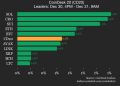
At the same time, Zcash has surged to the top of Coinbase’s internal search rankings, surpassing Bitcoin (BTC) and XRP (XRP) in user queries, a sign that retail attention has followed the move.

Analysts say the combination of sharp gains and rising search interest looks like a classic hot trade. The complicating factor is that it is happening in a part of the market facing mounting regulatory pressure, exchange delistings and sanctions-related scrutiny.
Did you know? Most dirty crypto does not move through privacy coins. Chainalysis’s 2025 crime report says stablecoins made up about 63% of all crypto transaction volume linked to illicit activity in 2024, having already overtaken Bitcoin as the preferred crypto for many criminal actors.
Privacy tokens as outliers: The numbers and narratives
The latest move has clearly been led by Zcash, with Monero following at a distance.
Key numbers analysts point to:
-
ZEC is up well over 200% in about a month on some major venues.
-
From late summer lows, point-to-point moves in ZEC reach high triple-digit percentage gains.
-
Monero has risen, too, but far less, allowing ZEC to briefly overtake it by market capitalization.
-
Despite the rally, ZEC still trades well below its historical all-time high.
Explanations fall into two broad camps:
-
One group focuses on structure and tech, including declining issuance as halvings progress and the planned NU6.1 upgrade, which shifts more funding control toward tokenholders.
-
Another points to narrative and market structure, including highly optimistic public price projections, concern about surveillance, thin order books and short squeezes in a relatively small segment of the market.
Most observers agree the rally is unfolding just as the regulatory and policy tide turns against anonymity-enhancing assets.
Did you know? Even after the recent rally, the entire privacy coin sector is worth about $30 billion-$35 billion, or roughly 1% of the total crypto market cap, according to CoinGecko category data.
Regulation is moving the other way
At the global level, privacy tokens sit squarely inside the Anti-Money Laundering (AML) debate.
Since 2019, the Financial Action Task Force (FATF) has applied its full AML and counter-terrorism-financing (CFT) standards to virtual assets and virtual asset service providers (VASPs), including the Travel Rule, which requires originator and beneficiary information to accompany qualifying transfers.
A targeted update in 2024 found that about three-quarters of assessed jurisdictions were still only partially or non-compliant with Recommendation 15, and about 30% had not yet implemented the Travel Rule in law. The FATF also flagged increasing use of anonymity-enhancing cryptocurrencies by illicit actors as a specific concern.
In Europe, the direction of travel is even clearer. New EU-wide AML rules centered on Regulation 2024/1624 and related legislation will ban anonymous crypto accounts and privacy coins on licensed platforms by 2027, according to legal and policy analyses.
Crypto asset service providers will be required to apply bank-style AML controls, verify the beneficial owners behind wallets that interact with their services and phase out support for fully anonymous instruments.
That does not mean these assets become illegal to hold everywhere. But it does mean that in much of the regulated financial system, infrastructure is being redesigned on the assumption that privacy tokens will be restricted or excluded.
Delistings, shrinking venues and liquidity risk
The regulatory backdrop has already started to reshape where and how privacy tokens trade.
Key shifts:
-
In 2024, privacy tokens saw nearly 60 delistings from centralized exchanges, the highest figure since 2021.
-
Monero accounted for the largest share of removals, with Dash (DASH) and others also affected as exchanges revisited AML policies.
-
Binance has restricted or removed trading in XMR, ZEC and DASH for users in several European jurisdictions, citing local rules and compliance.
-
Kraken announced in late 2024 that it would halt Monero trading and deposits for clients in the European Economic Area (EEA), with a withdrawal deadline at year-end and a clear reference to European Union regulatory changes, including the Markets in Crypto Assets (MiCA) framework.
These steps may create a classic liquidity dilemma. Thin markets can move sharply on comparatively small inflows during rallies. As trading migrates from large, well-capitalized venues to smaller or less regulated platforms, it can become harder for bigger holders to exit without moving the price. The same structure that enables sudden spikes can also increase the risk of air pockets on the way down.
Did you know? Some countries banned trading privacy coins years ago. Japan’s regulator pushed exchanges to drop Monero, Dash and Zcash in 2018, while South Korea banned privacy coins from domestic exchanges starting in March 2021, forcing local platforms to delist them entirely.
Sanctions spillover, court battles and compliance anxiety
Sanctions and enforcement actions have added another layer of uncertainty.
In 2022, the United States Treasury’s Office of Foreign Assets Control (OFAC) sanctioned Tornado Cash, alleging that the Ethereum-based mixer laundered billions of dollars, including funds linked to North Korea. In late 2024, a US appellate court found that sanctioning immutable smart contracts exceeded the Treasury’s authority, and in March 2025, the OFAC formally withdrew the designations.
However, the legal risk did not disappear. Tornado Cash developers have faced criminal proceedings in several jurisdictions, and one co-founder has been convicted on charges tied to operating an unlicensed money transmitting business.
A separate case involving Samourai Wallet sent a similar signal. In November 2025, its founders received multi-year prison sentences in the United States after pleading guilty to conspiring to operate an unlicensed money transmitting business, with prosecutors alleging that more than $2 billion in Bitcoin flowed through the service.
For compliance teams, the line between infrastructure and money transmitter is hard to draw. Several AML vendors and policy groups now place privacy coins, mixers and some high-risk decentralized finance (DeFi) tools in the same elevated risk band. Under pressure from the FATF and national regulators, many firms default to over-compliance by blocking deposits linked to privacy tools, declining listings and limiting payment use.
For users, this creates a secondary risk. Even if a specific coin or protocol is not sanctioned, the surrounding ecosystem may still treat it as too risky to touch.
What analysts are watching next
Analysts are divided on what this rally actually signals:
-
Some see it as a protest trade against growing onchain surveillance, data-sharing rules and sanctions screening.
-
Others view it as a late-cycle speculative spike in a shrinking niche, driven more by leverage and narratives than long-term demand.
Key milestones on the policy side:
-
EU AML rules that restrict or effectively ban privacy coins on licensed platforms are set to take full effect around 2027.
-
The FATF will continue publishing implementation reviews, and its latest reports say most jurisdictions are still only partially compliant with virtual asset standards and the Travel Rule.
On the technical side, upgrades like Zcash’s NU6.1 funding change and experiments with optional privacy layers on major networks may test whether stronger privacy can coexist with regulators’ demands for traceability.
For now, privacy tokens sit between a long-running debate over financial privacy and an intensifying global AML and sanctions regime. Awareness of legal, liquidity and enforcement risks is essential for understanding how this segment operates.