

For years, US banks treated Bitcoin as something best observed from a distance.
The asset lived on specialist exchanges and trading apps, walled off from core banking systems by capital rules, custody worries, and reputational risk.
However, that posture is finally giving way.
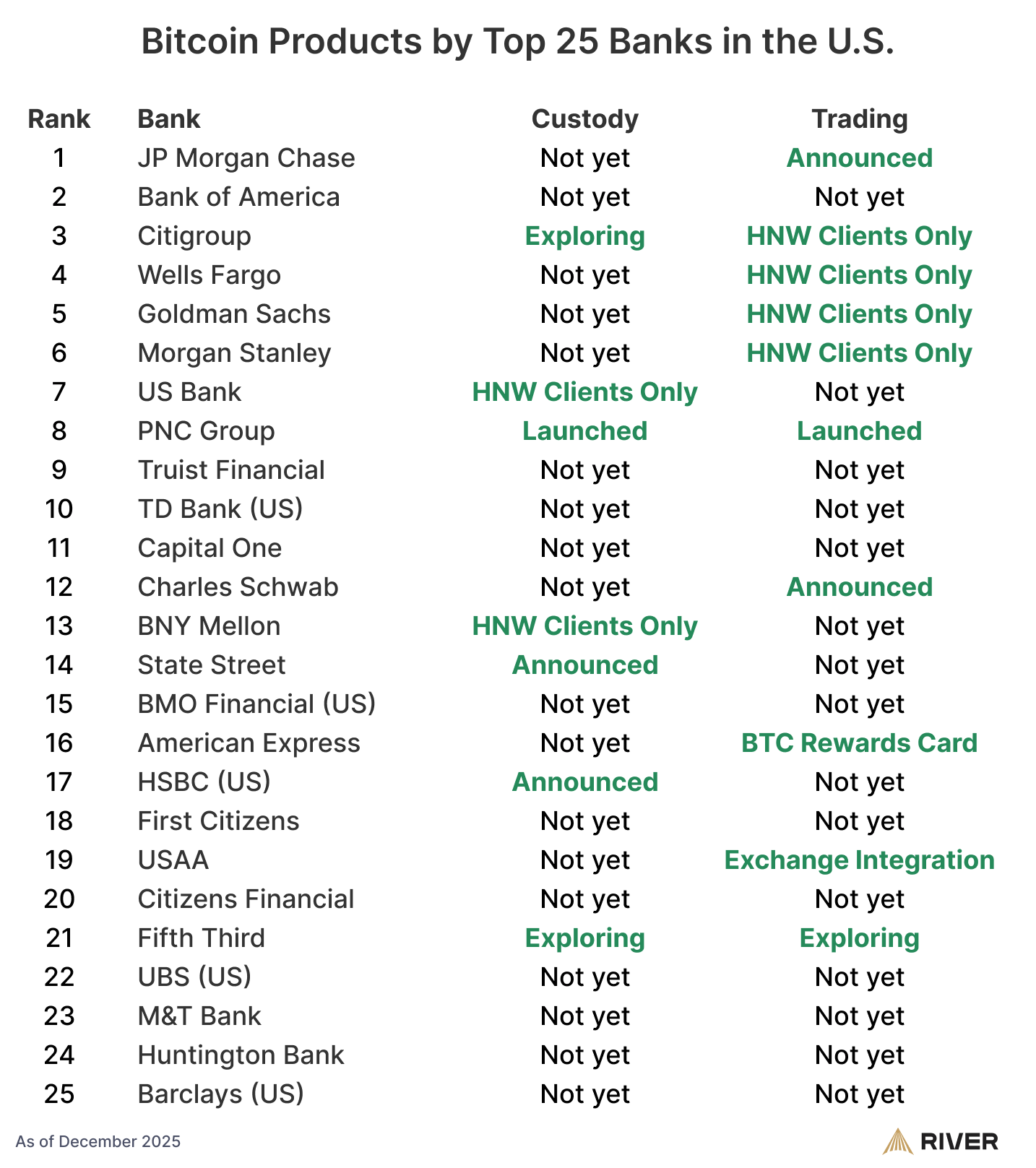
According to data from River, nearly 60% of the country’s 25 largest banks are now somewhere on the path to selling, safekeeping, or advising on Bitcoin directly.

Spot ETF approvals dominated the headlines of 2024. The story of 2025 is quieter: crypto is moving from fringe allocation to routine line item inside mainstream wealth and custody workflows.
If current timelines hold, 2026 is shaping up as the first year Bitcoin looks like a standard product rather than an exception.
From ETF pass-throughs to white-label trading
The ETF complex was phase one of institutional Bitcoin adoption. It gave banks a way to meet client demand inside a familiar wrapper, with asset managers and specialist custodians bearing most of the operational burden.
Notably, the ETF trading also supplied a real-time stress test for these institutions as flows have moved in both directions without breaking market plumbing.
For risk committees, the takeaway is that Bitcoin’s volatility can be managed within established supervisory frameworks, even if it hasn’t become any less volatile.
The next step is to let at least some clients hold and trade the underlying asset from the same interfaces they use for everything else.
PNC Financial Services Group’s private-bank rollout is the clearest example. Rather than build a crypto exchange, PNC is using Coinbase’s “Crypto-as-a-Service” stack.
The bank controls client relationships, suitability checks, and reporting, while Coinbase provides trading and key management services behind the scenes.
Variations of that “white-label” structure are becoming the industry compromise. It lets banks say “yes” to client demand without standing up their own wallet infrastructure or blockchain operations.
Moreover, recent guidance from the Office of the Comptroller of the Currency (OCC) has clarified how national banks can treat crypto trades as riskless principal transactions, in which a bank buys from a liquidity provider and sells to a client almost simultaneously.
That reduces the capital hit from market risk and makes it easier to slot Bitcoin desks alongside foreign-exchange or fixed-income operations.
Nonetheless, the stance remains cautious. Banks are starting with their most sophisticated customers and with narrow products.
For context, Charles Schwab and Morgan Stanley are targeting the first half of 2026 for spot Bitcoin and Ethereum trading on self-directed platforms.
Still, they are expected to meter access with hard allocation caps, conservative margin rules, and tighter eligibility screens.
A regulatory stack
Underpinning this shift is a regulatory and charter landscape that increasingly fits traditional institutions more neatly than their upstart competitors.
The GENIUS Act has established a federal framework for stablecoin issuers. The OCC has issued conditional national trust charters to crypto firms, creating a class of regulated counterparties that can sit inside existing risk and capital regimes.
That combination lets banks assemble plug-and-play stacks. US Bancorp has revived its institutional Bitcoin custody service with NYDIG as sub-custodian.
Other large incumbents, including BNY Mellon, are building digital-asset platforms aimed at institutions that would prefer to see their Bitcoin held by the same brands that safeguard Treasuries and mutual funds.
For wealthy clients, the optics matter. Buying Bitcoin through a Morgan Stanley or Schwab interface, with positions showing up in the same dashboards and statements as other securities, feels fundamentally different from wiring funds to an offshore venue.
So, banks are using that trust and regulatory standing to reposition crypto exchanges and infrastructure firms as back-end utilities rather than front-of-house brands.
As a result, the timetable for normalization is compressed but not instantaneous.
Bank of America plans to allow advisors across Merrill, the private bank, and Merrill Edge to recommend crypto exchange-traded products from January 2026.
This would shift Bitcoin from “unsolicited” access to assets that can be slotted into model portfolios, giving them exposure to the same allocation machinery that channels flows into equity and bond ETFs.
New plumbing, new risk
The same architecture that makes it easier for banks to move quickly also imports new vulnerabilities.
Most institutions offering or planning crypto access are not building their own vaults. Instead, they are relying on a small set of infrastructure providers, such as Coinbase, NYDIG, and Fireblocks, for execution, wallet technology, and key security.
That concentration creates a different kind of systemic risk. The riskless principal model and ETF wrappers limit the amount of outright market risk banks need to carry on their balance sheets.
However, they do not remove counterparty and operational risk.
So, a major outage, cyber incident, or enforcement action at a core sub-custodian would not only affect retail crypto traders but could also ripple through private-bank divisions, institutional custody businesses, and model portfolios at multiple large institutions simultaneously.
Considering this, the banks are literally tying their own reputations and service levels to the resilience of vendors that did not exist a decade ago.
Risk teams can try to mitigate that by insisting on modularity so that vendors can be swapped, and by keeping early programs small relative to overall assets.
But the direction of travel is clear: a growing share of Bitcoin exposure will sit at the intersection of large banks’ wealth platforms and a concentrated set of crypto specialists.
From pilot to standard offering
Despite the residual risks, the integration is moving.
US Bancorp’s custody restart, PNC’s private-bank trading, Schwab and Morgan Stanley’s 2026 targets, Bank of America’s advisory green light, and JPMorgan’s crypto embrace, all point toward the same outcome: Bitcoin woven into the operational fabric of mainstream finance rather than orbiting outside it.
None of this guarantees a smooth transition because BTC price volatility remains, policy can swing, and a serious incident in crypto infrastructure could slow or reverse parts of the roadmap.
However, if the current trajectory holds, by 2026, the question facing many wealth clients will be less about whether their bank offers Bitcoin at all and more about how their exposure is split between ETFs, direct holdings, and advisory models. It will also be about which institution they trust to sit between them and the underlying rails.
Banks may not have chosen Bitcoin as their preferred innovation project. They are embracing it because their clients have already done so.
The pivot now underway is about building enough machinery around the asset to keep those clients, and their balances, from drifting permanently somewhere else.